Discover why the Best Healthcare Digital Marketing Services in USA matter more than ever in 2026. This guide covers SEO, local search, PPC, content, reputation management, and AI-driven visibility strategies—plus real costs, HIPAA compliance tips, and a partner checklist to help your practice win patients before rivals capture them.
Best Healthcare Digital Marketing Services in USA

Here is a number that should stop every practice owner mid-scroll: 82% of patients now use search engines to find a healthcare provider, and roughly 7% of all daily Google searches — about 1 billion queries every single day — are health-related (WebFX). If your clinic, hospital, or health brand is invisible online, you are not just losing clicks — you are losing patients to whoever ranks above you. That is exactly why finding the best healthcare digital marketing services in USA has become a survival decision, not a marketing luxury. In this guide, we break down the ten services that actually move the needle in 2026, what they cost, how to stay HIPAA-compliant, and how to choose a partner like Go Digital Alpha that turns searches into scheduled appointments.
Key Takeaways
What Is Healthcare Digital Marketing?
Why US Healthcare Providers Can’t Afford to Ignore Digital Marketing in 2026
The 10 Best Healthcare Digital Marketing Services in USA (Ranked for 2026)
How to Choose the Best Healthcare Digital Marketing Partner in the USA
What Is Healthcare Digital Marketing?

Healthcare digital marketing is the use of online channels — search engines, paid ads, social media, websites, email, and AI-powered search platforms — to attract, educate, and convert patients while staying compliant with privacy laws like HIPAA. Unlike generic marketing, it must balance persuasion with medical accuracy, patient trust, and strict data protection.
The stakes are enormous. The healthcare digital marketing market is valued at $6.4 billion in 2026 and growing at 18% annually (Marketing LTB). Hospitals with a strong digital presence see 28% more new patient acquisitions than those relying on traditional marketing, and patients under 45 are 3.2x more likely to choose a provider based on online presence than on personal referrals (Searchlab). In short: the waiting room of 2026 is filled from a search results page.
Why US Healthcare Providers Can't Afford to Ignore Digital Marketing in 2026

The patient journey has fundamentally changed, and the data proves it:
- “Doctor near me” searches have grown 185% since 2020, and more than 70,000 health-related Google searches happen every minute (Invoca).
- Google accounts for 93% of healthcare discovery online — meaning if you don’t rank, you effectively don’t exist for new patients (Blacksmith Agency).
- 78% of patients expect to book appointments online, yet only 41% of practices offer full online scheduling (Revenue Memo) — a massive conversion gap for early movers.
- AI search is rewriting the rules. Google’s AI Overviews now reach 1.5 billion users monthly, and ChatGPT alone serves hundreds of millions of weekly users asking health questions. Practices optimized for AI answers capture patients their competitors never even see.
The message is clear: patients research symptoms, compare providers, read reviews, and book care digitally. The following ten services are how the best-performing healthcare brands in the USA capture that demand.
The 10 Best Healthcare Digital Marketing Services in USA (Ranked for 2026)
Several agencies have earned strong reputations for delivering measurable results in the UAE property sector. Based on rankings from Clutch , Semrush, and SuperbCompanies, the following names consistently appear among the best:
Go Digital Alpha — The Foundation of Patient Acquisition
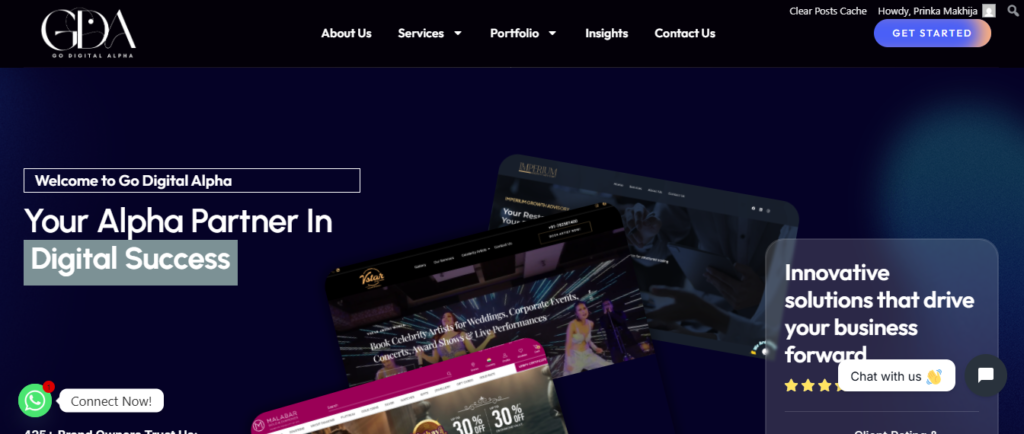
GDA is the single highest-ROI digital marketing service for medical practices because it captures patients at the exact moment of need. When someone types “knee replacement surgeon in Houston” or “pediatric dentist near me,” SEO determines whether they find you or your competitor.
A complete healthcare SEO program includes condition- and procedure-focused keyword targeting, medically accurate content that satisfies Google’s E-E-A-T (Experience, Expertise, Authoritativeness, Trustworthiness) standards, technical site health, and authoritative link building. Since 92% of AI Overview citations come from top-10 ranking pages, strong SEO now doubles as your ticket into AI-generated answers.
Leading agencies reviewed by Clutch consistently list SEO as the core service healthcare organizations buy first. A specialized team like the one behind Go Digital Alpha’s SEO services builds rankings that compound month after month — unlike ads, which stop the moment you stop paying.
At GoDigitalAlpha, the elite provided services are as follows:
Local SEO & Google Business Profile Optimization — Owning the “Near Me” Moment
For clinics, hospitals, dental offices, and multi-location practices, local SEO is where the money is. The map pack (the three local listings at the top of Google) captures the lion’s share of clicks for “near me” searches — and those searches have nearly tripled since 2020 (Invoca).
Local SEO services include Google Business Profile optimization, NAP (name, address, phone) consistency across directories, local review generation, location page creation for multi-site groups, and local schema markup. For a practice with multiple locations, each office needs its own optimized presence — a specialty of agencies experienced with healthcare portfolios across markets.
The payoff is direct: patients who find a practice in the map pack are typically ready to call or book immediately, making local SEO one of the shortest paths from marketing spend to booked appointments.
PPC & Paid Search Advertising — Instant Visibility for High-Value Procedures
While SEO compounds over time, pay-per-click (PPC) advertising delivers patients this week. Google Ads for healthcare puts your practice at the very top of search results for high-intent queries like “urgent care open now” or “LASIK cost near me.”
The best healthcare PPC programs go beyond basic search ads to include appointment-focused campaign structures, call tracking, landing pages built for conversion, remarketing (with careful HIPAA handling), and paid social campaigns on Facebook, Instagram, and LinkedIn. Agencies like Silverback Strategies note that appointment-focused PPC paired with conversion-optimized site experiences is what separates healthcare-specialist agencies from generalists.
One critical caveat: ad platforms such as Google and Meta do not sign Business Associate Agreements, so campaigns must be architected to never transmit protected health information (Piwik PRO). A specialized search engine marketing partner builds this compliance in from day one.
Medical Content Marketing — Building Trust Before the First Appointment
Patients don’t just search for providers; they search for answers. “Is this mole normal?” “What does an MRI cost?” “How long is recovery from ACL surgery?” Practices that answer these questions with expert, medically reviewed content earn trust — and rankings — long before a patient picks up the phone.
Effective healthcare content marketing includes condition and treatment pages, physician-reviewed blog articles, patient education guides, video scripts, and FAQ content structured to win featured snippets and AI citations. Content with clear structure, cited statistics, and author credentials is dramatically more likely to be referenced by Google’s AI Overviews, ChatGPT, and Perplexity.
This is also where E-E-A-T becomes non-negotiable: Google holds health content (classified as “Your Money or Your Life”) to its highest quality standards. Professional content writing services that pair SEO strategy with medical accuracy give practices a durable competitive moat that paid ads can never replicate.
Online Reputation & Review Management — Your Digital Word-of-Mouth
Before booking, patients read reviews — and a single star of difference on Google can visibly swing appointment volume. Reputation management has become a core service at every top healthcare agency because positive reviews and accurate listings directly build patient trust (G&CO).
A complete reputation program includes automated (HIPAA-safe) review requests after visits, monitoring across Google, Healthgrades, Zocdoc, Vitals, and Yelp, professional response management, and crisis mitigation when negative feedback appears. Importantly, responses must never confirm someone is a patient or reference their care — a compliance trap that generalist agencies routinely fall into (HHS.gov).
Done right, reputation management creates a flywheel: more five-star reviews improve local rankings, better rankings drive more patients, and more happy patients generate more reviews.
Healthcare Website Design & Development — Where Clicks Become Appointments
Your website is your digital front door, and patients judge it in seconds. Slow load times, confusing navigation, or the absence of online booking sends patients straight back to search results. Remember: 78% of patients expect online scheduling, but only 41% of practices deliver it (Revenue Memo).
Modern healthcare web development includes mobile-first responsive design, ADA accessibility compliance, HIPAA-compliant forms, online appointment scheduling, provider directories, fast Core Web Vitals scores, and server-side rendering so both patients and AI crawlers can read your content. Conversion rate optimization (CRO) — testing headlines, forms, and calls-to-action — routinely lifts appointment conversions by double digits.
An experienced website development team builds sites that don’t just look clinical-grade — they convert traffic into booked visits, which is the only metric that ultimately matters.
Social Media Marketing for Healthcare — Community, Credibility, and Reach
Healthcare social media has matured far beyond posting health tips. In 2026, it drives measurable patient acquisition through physician spotlight videos, patient education Reels, community engagement, and targeted paid social campaigns. Younger demographics increasingly discover providers on Instagram and TikTok before ever searching Google.
The compliance dimension is critical: no patient information can ever appear without written authorization, and testimonials require explicit consent. Specialist agencies build content calendars that humanize providers — team introductions, behind-the-scenes content, myth-busting explainers — while legal-proofing every post.
Platforms like YouTube also feed AI visibility: brand mentions on YouTube show the strongest correlation with AI-search citations of any platform (Ahrefs, 2025 study of 75,000 brands). A strategic social media marketing program therefore compounds across channels — building brand searches, review volume, and AI-answer presence simultaneously.
AI Search Optimization (GEO/AEO) — The New Frontier of Patient Discovery
The fastest-growing service on this list barely existed three years ago. Generative Engine Optimization (GEO) — also called Answer Engine Optimization (AEO) — ensures your practice appears when patients ask ChatGPT, Perplexity, Gemini, or Google’s AI Overviews questions like “best cardiologist in Chicago” or “what should I look for in an IVF clinic?”
AI-referred website sessions grew over 500% in a single year, and AI Overviews now appear on more than half of all Google queries. Optimizing for this channel means creating self-contained, citable answer passages, question-based headings, structured data (schema markup), consistent entity information across the web, and allowing AI crawlers like GPTBot and PerplexityBot in your robots.txt.
Google’s own guidance confirms that GEO is fundamentally excellent SEO applied to AI surfaces — which is why practices working with a forward-looking digital marketing agency get AI visibility as a natural extension of their SEO program rather than an expensive add-on.
Email & Patient Retention Marketing — The Highest-ROI Channel You Already Own
Acquiring a new patient costs five to seven times more than retaining an existing one, yet most practices chronically underinvest in retention. Email and SMS marketing fixes that: appointment reminders, recall campaigns (“time for your annual check-up”), newsletters, post-visit follow-ups, and reactivation campaigns for lapsed patients.
Healthcare email marketing consistently produces among the highest ROI of any digital channel because the audience already knows and trusts you. The compliance requirement is a HIPAA-compliant email platform with a signed Business Associate Agreement — standard consumer tools won’t qualify (SmartBug Media).
Well-built automation sequences run in the background, filling schedule gaps and increasing patient lifetime value while your acquisition channels bring in new demand — a combination that dramatically lowers your blended cost per appointment.
Analytics, Call Tracking & HIPAA-Compliant Reporting — Proving What Works
The final service separates professional healthcare marketing from guesswork: measurement. Which campaigns produced booked appointments? What does a new patient actually cost by channel? Which service lines are growing?
Healthcare analytics requires special care because standard tools like Google Analytics 4 don’t offer BAAs and prohibit protected health information in their platforms (Improvado). Best-practice setups use privacy-first analytics, HIPAA-compliant call tracking, CRM integration, and dashboards that report real business outcomes — appointments and revenue, not vanity metrics like impressions.
Agencies that lead with data, transparent reporting, and continuous optimization deliver compounding returns; those that report “likes” and “reach” deliver invoices. Always ask a prospective partner to show you a sample monthly report before signing.
How to Choose the Best Healthcare Digital Marketing Partner in the USA

With hundreds of agencies competing for your budget — from healthcare-exclusive shops like those ranked by Thrive Agency to full-service global firms — use this evaluation checklist:
- Healthcare experience with proof. Ask for case studies with real numbers: rankings gained, appointment volume, cost per acquisition. Review their healthcare portfolio before you commit.
- HIPAA fluency. They should raise compliance before you do — BAAs, PHI-safe ad architecture, compliant review responses. Fines start at $141 per violation and can reach $2.1 million annually (Ditans Group).
- Full-funnel capability. Patient acquisition needs SEO, PPC, content, web, reputation, and retention working together — not six disconnected vendors.
- AI-search readiness. Ask specifically how they optimize for AI Overviews and ChatGPT. Blank stares are disqualifying in 2026.
- Transparent reporting. Monthly reports should show appointments and ROI, not just traffic.
- Cultural fit and communication. You’ll work with this team weekly. Responsiveness and clarity matter as much as expertise.
Teams like Go Digital Alpha — trusted by 425+ brands with a dedicated global healthcare portfolio — combine all six criteria under one roof, with 24/7 support and a four-step process that moves from free consultation to customized strategy, implementation, and continuous data-driven optimization.
The Bottom Line: Visibility Is the New Bedside Manner

Healthcare has changed forever: 1 billion health searches a day, AI assistants recommending providers, and patients who judge your practice by its website before they ever meet your staff. The practices winning in 2026 aren’t necessarily the ones with the best clinicians — they’re the ones patients can actually find.
The best healthcare digital marketing services in USA share one formula: SEO and local visibility as the foundation, PPC for immediate demand, content and reputation for trust, a conversion-built website to capture it all, and HIPAA-compliant measurement to prove ROI — now extended into AI search, where tomorrow’s patients are already asking questions.
Ready to become the practice patients find first? Contact Go Digital Alpha for a free consultation, explore our healthcare portfolio, or browse more growth strategies on our Insights blog. Your next 100 patients are searching right now — make sure they find you.
FAQs
Healthcare SEO delivers the highest long-term ROI because it captures patients actively searching for care and compounds over time. However, the best results come from combining SEO with PPC (for immediate visibility), reputation management (for trust), and a conversion-optimized website. Most successful practices run an integrated program rather than a single channel.
Most US healthcare practices invest between $1,500 and $10,000+ per month depending on market competitiveness, number of locations, and service mix. Comprehensive AI-driven packages start around $1,399/month at specialist providers (PatientGain), while multi-location health systems often invest $25,000+ monthly. Expect meaningful SEO results in 4–6 months and PPC results within weeks.
Yes — when done correctly. HIPAA-compliant marketing means never using protected health information (PHI) in ads, analytics, or public responses without authorization. Your agency must sign a Business Associate Agreement (BAA) if it touches any system containing patient data, and campaigns must avoid pixel-based tracking that transmits PHI (HHS.gov).
Typically 4–6 months for meaningful ranking improvements and 6–12 months for full momentum, depending on your market and starting point. Local SEO (map pack visibility) often moves faster — sometimes within 60–90 days. SEO is a compounding asset: results accelerate over time, unlike paid ads which stop when spending stops.
SEO earns organic rankings through content, technical optimization, and authority — it takes months but delivers durable, low-cost patient flow. PPC buys immediate top-of-page placement — it works instantly but costs money for every click. The smartest strategy uses PPC for immediate patient volume while SEO builds, then shifts budget toward organic as rankings mature.
Overwhelmingly, yes. 82% of patients use search engines to find providers, Google handles 93% of healthcare discovery online, and "doctor near me" searches have grown 185% since 2020 (Invoca). Patients under 45 are 3.2x more likely to choose a provider based on online presence than personal referrals.
Generative Engine Optimization (GEO) is the practice of optimizing your content so AI platforms — ChatGPT, Perplexity, Google AI Overviews — cite and recommend your practice when patients ask health questions. It involves citable answer passages, structured data, question-based headings, and allowing AI crawlers site access. With AI-referred traffic growing over 500% year-over-year, it's the fastest-emerging channel in healthcare marketing.
Because reviews are the modern referral. The overwhelming majority of patients read online reviews before booking, and review ratings directly influence both patient choice and local search rankings. Professional reputation management generates authentic reviews at scale, responds compliantly (never confirming patient status), and protects your practice during negative-feedback events.
For most small and mid-sized practices, a specialized agency wins on cost and results. A single in-house marketer costs $60,000–$90,000+ annually and can't master SEO, PPC, content, web development, and compliance simultaneously. An agency delivers a full specialist team — often for less than one salary — with proven healthcare playbooks from day one.
Track appointments and revenue, not vanity metrics. The essentials: cost per new patient by channel, booked appointments from web forms and tracked calls, patient lifetime value, and service-line growth. Use HIPAA-compliant call tracking and analytics (Improvado), and demand monthly reporting that ties spend directly to patient volume.
Sources:
- WebFX – 65+ Healthcare Marketing Statistics
- Invoca – 40+ Healthcare Marketing Statistics
- Marketing LTB – Healthcare Marketing Statistics 2026
- Searchlab – Healthcare Marketing Statistics 2026
- Blacksmith Agency – Top 45 Healthcare Statistics
- Revenue Memo – Healthcare Marketing Statistics
- Thrive Agency – 13 Best Healthcare Digital Marketing Agencies
- Clutch – Top Healthcare Digital Marketing Agencies in the US
- G&CO – Top Healthcare Marketing Agencies
- Silverback Strategies – Best Healthcare Digital Marketing Agencies
- HHS.gov – HIPAA Marketing FAQ
- Piwik PRO – HIPAA-Compliant Marketing & Advertising
- SmartBug Media – HIPAA-Compliant Healthcare Marketing
- Ditans Group – HIPAA-Compliant Digital Marketing
- Improvado – HIPAA-Compliant Marketing Analytics
- PatientGain – Healthcare Marketing Pricing
Share this post :
Go Digital Alpha — The Foundation of Patient Acquisition
Newsletter
Latest Post